




Report of the Public Lecture
The 44th Public Lecture on Criminal Justice Policy was held on 30 January 2026. UNAFEI, the Japan Criminal Policy Society Foundation (JCPS) and the Asia Crime Prevention Foundation (ACPF) have hosted this annual event since 1982.
The event was held in a hybrid format (in-person and online) so that many participants from both Japan and overseas could participate. As a result, 103 in-person participants and 115 online participants attended, which shows that the lecture topic was of great interest to the public.
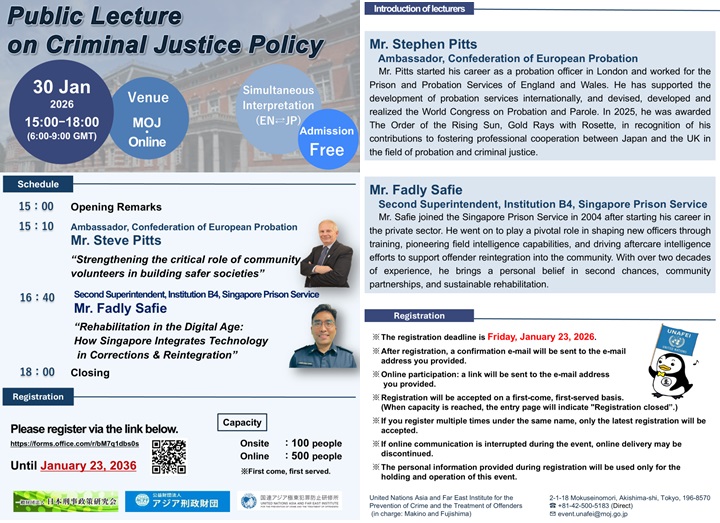
Lectures
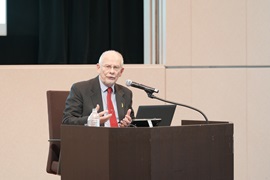
Mr. Steve Pitts, Ambassador for the Confederation of European Probation, spoke on the important role
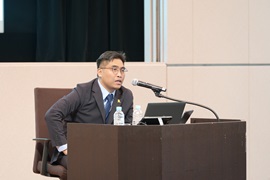
of community volunteers in building a safe and secure society, whereas Mr. Fadly Safie, Second
Superintendent of Institution B4 at Singapore's Changi Prison, spoke on the introduction of IT in the
field of probation and correctional services.
Lecture 1
“Strengthening the critical role of community volunteers in building safer societies”
Mr. Steve Pitts
Ambassador, Confederation of European Probation (CEP)
Lecture slides are available here
Lecture 2
“Rehabilitation in the Digital Age: How Singapore Integrates Technology
in Corrections & Reintegration”
Mr. Fadly Safie
Second Superintendent, Institution B4, Singapore Prison Service (SPS)
Lecture slides are available here
Overview of the Lectures
Mr. Pitts presented on “Strengthening the critical role of community volunteers in building safer
societies.” He shared insights on community volunteering within the context of the history and
background of the probation system in the UK, the current state and challenges of volunteer activities
in the rehabilitation and probation field across Europe and international trends such as the development
of the United Nations Model Strategies on Reducing Reoffending, along with good practices on
community volunteers supporting offender rehabilitation from various countries. Notably, he
introduced the CoPPer Project, which is implemented by CEP and aims to promote the active
engagement of citizens and civil society in the reintegration and inclusion of people that commit
crimes in Europe, and emphasized that this project is inspired by the hogoshi (volunteer probation
officers) system in Japan.
Mr. Safie presented on “Rehabilitation in the Digital Age: How Singapore
Integrates Technology in Corrections & Reintegration,” introducing
the current status of IT-enabled treatment within facilities and in the
community in Singapore. He shared Singapore's current efforts to explore
better, smarter correctional administration through technology, addressing
challenges such as the aging inmate population, and resource constraints
like labour shortages, as well as the need to maintain family connections
and community engagement. His presentation conveyed SPS’s strong initiatives
to introduce state-of-the-art technology to facilitate offender management
and rehabilitation within correctional facilities and in the community.
He also emphasized that by utilizing technology, it is possible to overcome
resource-related challenges and ensure the human involvement necessary
for reducing reoffending.
Both lectures provided exemplary practices for reducing reoffending and building a safer, more secure
society—such as community-involved efforts and utilizing IT to optimize resources for offender
rehabilitation and correctional administration, which contribute to the promotion of the UN Model
Strategies on Reducing Reoffending.
We sincerely hope this lecture series has provided valuable insights and perspectives for the future
activities of all those involved in crime prevention and criminal justice policy and practice.
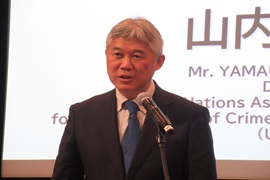
Director of UNAFEI
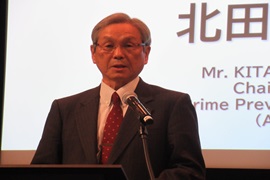
President of ACPF
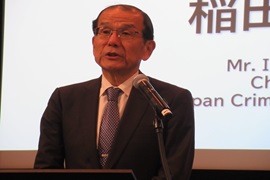
Chairperson of JCPS
- Public Lecture 2025
- Public Lecture 2024
- Public Lecture 2023
- Public Lecture 2022
- Public Lecture 2021
- Public Lecture 2020
- Public Lecture 2019
- Public Lecture 2018
- Public Lecture 2017
- Public Lecture 2016
- Public Lecture 2015
- Public Lecture 2014
- Public Lecture 2013
- Public Lecture 2012
- Public Lecture 2011
- Public Lecture 2010
